WWomen & Work
All Stories
Netherlands · 12 min read

Radmila

Founder of SelfStartGlobal (EdTech)

Law → EdTech
We only stayed in business because we kept moving forward.
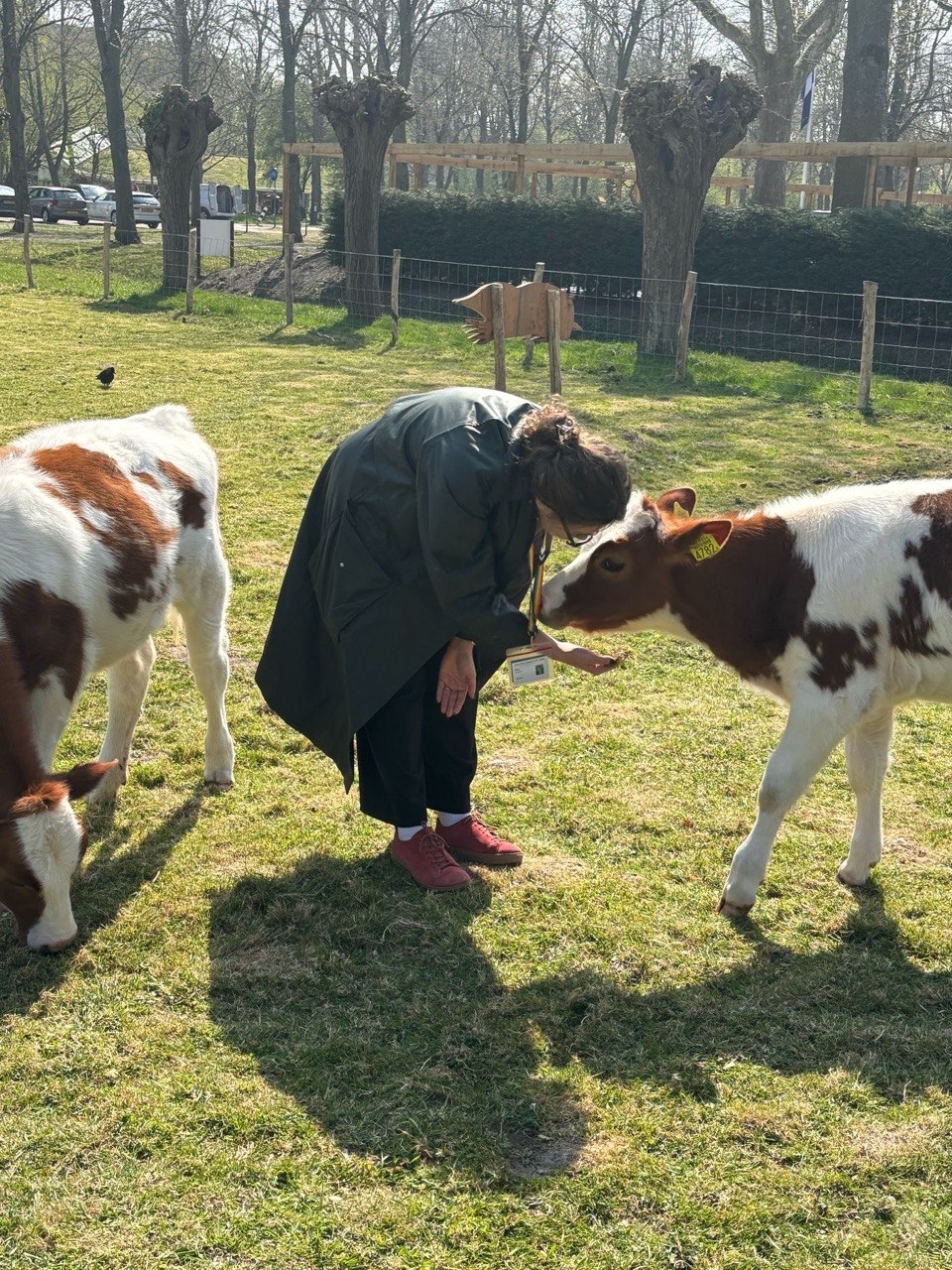
Radmila, founder of SelfStartGlobal, holding a laptop.
Quick Facts
Field
International education (EdTech): admission to universities in the US, Europe and Asia with scholarships. Head office — Amsterdam.
Results
1,700+ students admitted, 99% on the first attempt, 15,000+ offers from universities. Average scholarship — around $119,000 per student (2023–2024).
Students
Columbia, Yale, UCLA, University of Chicago, NYU, Oxford, Maastricht and other universities.
Licenses and memberships
ICEF, NACAC, Dutch EdTech. There is an in-house English school, Self Start English.
Mission
To help ambitious students get an education abroad for free or at minimal cost.
Links
selfstartglobal.com · Instagram @selfstartglobal
The Story

One day, at a small Dutch office, a manager pulled Radmila up on something: you can’t eat at your desk — crumbs get into the laptop. She — a lawyer with two master’s degrees and a diploma from Manhattan — was sitting over contracts that did nothing to inspire her, thinking just one thing: “I want to decide for myself where I get to eat.”

Today she has her own company in international education — “SelfStartGlobal.” Around fifty people on the team, more than 1,700 students admitted, universities on the level of Yale and Oxford — and growth she calls “her own,” because it was built without a single euro of outside investment. And it all began with an online course she made in the evenings, quietly, and on which she earned 49 euros in the first month.

We talked about how a whole ecosystem grew out of that failure, why an entrepreneur’s freedom turned out to be nothing like the dream, and what Radmila came to understand about fear — and about herself — over these seven years.

From law — to her real self

See how it works from the inside — Radmila shares it all on the SelfStartGlobal project.

Instagram: @selfstartglobal

Let’s start simple: where do you live now and what do you do?

I live in the Netherlands, in Haarlem. My project is called “SelfStartGlobal”; it’s in international education, but I call it EdTech. We help people get into universities abroad — in the US, Europe, Asia — and, most importantly, win scholarships. Our mission is for young people from Eastern Europe and the CIS to be able to study abroad at prestigious universities at minimal cost.

What’s your background? What did you do before the business?

I’m actually a lawyer by training: a bachelor’s and two master’s degrees. I studied in Kyiv, and then I decided to apply abroad — and that’s exactly where my business began. I really wanted to go far away, to live the student life, make my own decisions, feel independent. At home I lived with my parents, a complete absence of emancipation. I wanted to break that.

I applied for law, because I understood that with my background it would be the easiest route. In the end I got into six universities in the US, four offered me various scholarships, and one covered about 90% of tuition — that’s what allowed me to accept the offer and leave. That was 2016. Back then almost no one in my circle knew you could get into a university abroad on a scholarship, that our students get admitted at all. And that, I suppose, is where my path began — telling people that it’s real, you just need to know how to do it.
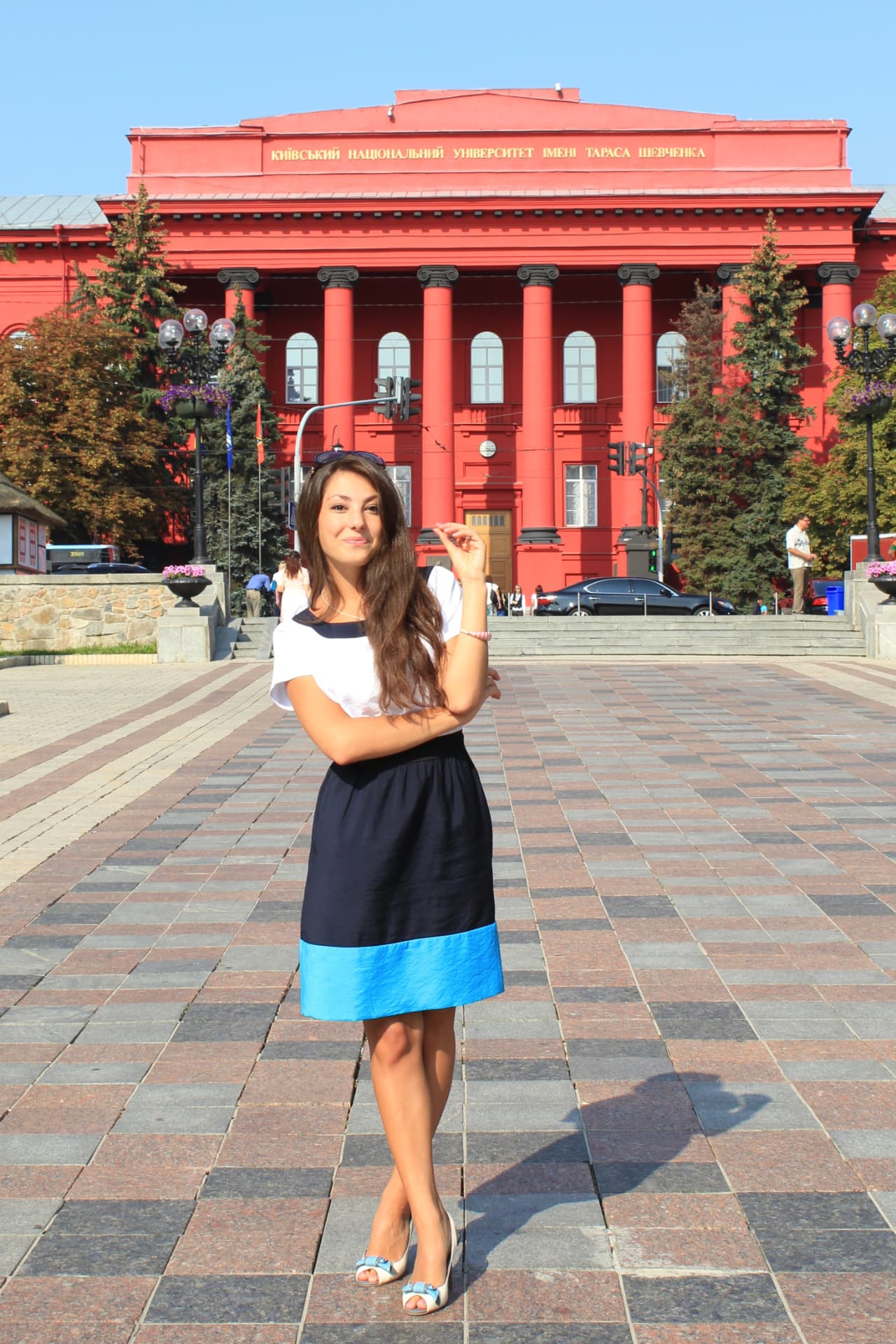
Radmila by the building of Taras Shevchenko National University of Kyiv.
Kyiv, Taras Shevchenko National University — where the path in law began.

I studied, then passed the bar exam in New York — I thought I’d stay and work as a lawyer. But fate had other plans: while studying, I met a Dutch guy and decided to move to the Netherlands to be with him. For love.

Let’s go through the timeline so we don’t get confused. What years were these?

In 2016 I left for the States — exactly ten years ago. At the end of 2018 I moved to the Netherlands. And in August 2019 I registered the company — next month it will be exactly seven years. But registering doesn’t mean I started actively selling. It’s more the date from which I began doing anything at all in this field: writing my first course.

How did that period of finding yourself in the Netherlands go?

The legal path here turned out to be very narrow. To work in the profession, you needed either to know Dutch or to get into a large international firm — and they weren’t hiring me. In the end I took a job at a small company where I could only do corporate and contract law, the things you can do in English. I disliked it completely. Every day I came home unhappy.

And to keep from losing my mind, I started looking for some kind of outlet — anything I actually enjoyed. In the evenings, sometimes quietly at work, I began making a course on applying abroad. Hoping I’d record it, launch it and sell it. There was far less information back then than there is now, and there were almost no companies in this niche. I gathered everything I knew myself, looked for information online, made presentations.
A failure for 49 euros

And what became of that first course?

I spent about eight months on it. A thousand hours, probably. I’d come home in the evening and write the scripts for recording, then make a presentation for each lesson, then record the audio for each lesson myself. Not like now, when you can put a presentation together in five minutes — I wrote every word by hand. I still remember it with a slight PTSD; there’s no way I’d do it like that today.

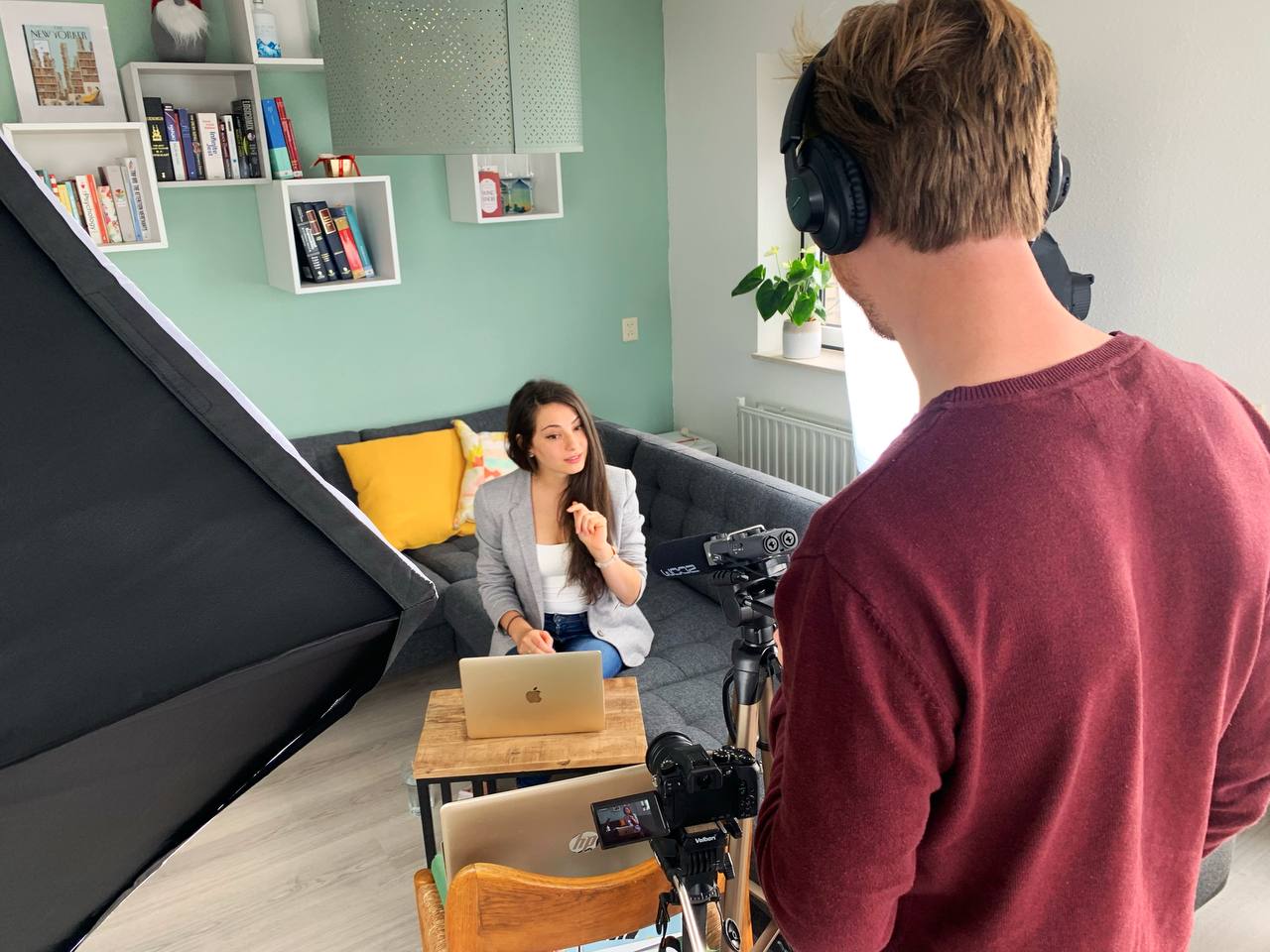
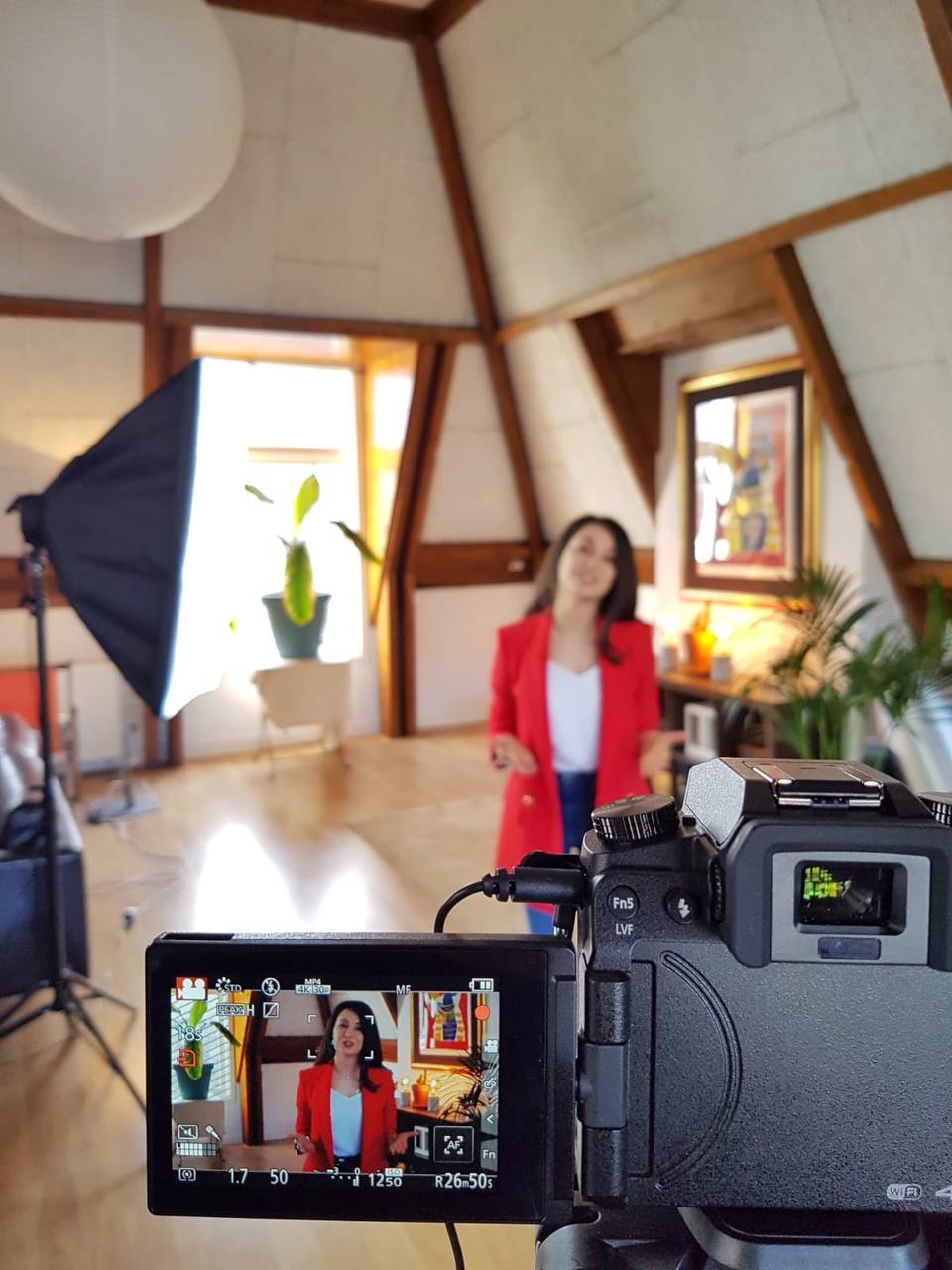
Radmila in a red blazer during a video shoot.
Behind the scenes: filming educational content.

So I recorded everything, got ready to launch — and COVID hit. In the first month I earned 49 euros. When recording the course had cost several thousand. A couple more months of trying to promote it, I even started learning paid ads myself — and still nothing. The course went on the shelf. That’s how my first idea of leaving employment failed: I’d been counting on that course.

But honestly, COVID gave me the best thing that ever happened to me: two extra hours a day and the chance not to commute to the office. And that freed-up time I poured into what everything eventually grew from.

How a company grew out of a failure

Tell us how a company grew out of that failure.

From March 2020, when COVID began, I started building up Instagram — I set up an account, began figuring out paid ads, making stories and posts. By May I’d hired two girls as SMM specialists, though I’d planned to take one — I just liked them both. Imagine: I’m getting a salary as an employee and out of it I’m paying salaries to other people, while the business isn’t bringing me anything yet. Every month around a thousand euros went out, mostly on ads, which at first converted into almost nothing. But I believed so strongly that I’d break even that I kept going.

I was getting a salary as an employee — and out of it I was paying salaries to other people, while the business wasn’t bringing me anything yet

By mid-2021 I hired my first expert curators, because there were more clients than I could handle on my own. I was still talking to every client, but I was already handing off part of the work, checking it and passing it on. And in August 2021 — exactly two years after registering the company — I left my job.

I left because I realized I was earning almost as much from my own company as from employment — a little less, but while spending only a pitiful number of hours on it. I was a terrible employee by the end, honestly: one or two emails a day, and the rest of the time I was managing my own team. They couldn’t fire me, I had a permanent contract; they hinted, carefully, in the Dutch way, at a review — that my heart, perhaps, lay in something else. And they were right.

What kind of figures were we talking about when you decided to leave?

In August 2021, when I left, I had around 3,000 euros a month left after covering all the company’s expenses — money I could take for myself. Turnover was higher, but net it came out a little less than my salary as an employee. But it was stable, several months in a row. And I understood: if I put all forty hours a week into the company instead of these pitiful evening hours, I would definitely increase that figure. Those two years I worked evenings and weekends without a break. I couldn’t do it like that now. But back then I had enormous drive and a desire to leave employment.

And the legal form? Did you register as a sole trader?

I registered as a ZZP — an entrepreneur. My whole team is scattered around the world; no one is based in the Netherlands. There are already 50 of us now.

I’ll be honest about taxes — the burden is heavy. Every year I think: maybe I should open a company somewhere else, move to Dubai. And every year I still don’t do it. In the Netherlands they generally advise against opening a company, and even more against hiring people on staff: give someone a third contract and it becomes virtually impossible to let them go. Big risks.

What happened after you left employment? How did the team grow?

By the time I left my main job there were about eleven people on the team, and that could no longer be managed alongside a job — it needed to be done full-time. And in 2022 I made my first truly important hire: I brought on an HR person. And I consider it the best decision of my life.

Bringing on an expert HR turned out to be the best decision of my life

Many founders think HR is something for the very end — why do you even need it? But I hired a person with experience at a large corporation, who understands how to set up KPIs, how a company should run, how to build departments. Thanks to her we formed customer success, sales, marketing, HR, finance, a legal department — and, most importantly, a culture within them. From 2022, after the right hiring decisions, we started growing really well. My intuition didn’t let me down back then.

Fast-forward to now — we have about fifty people on the team plus another ten or so contractors partly outsourced. The biggest department, of course, is customer success, with the curators who guide clients. There are lots of problems, but we’re growing.

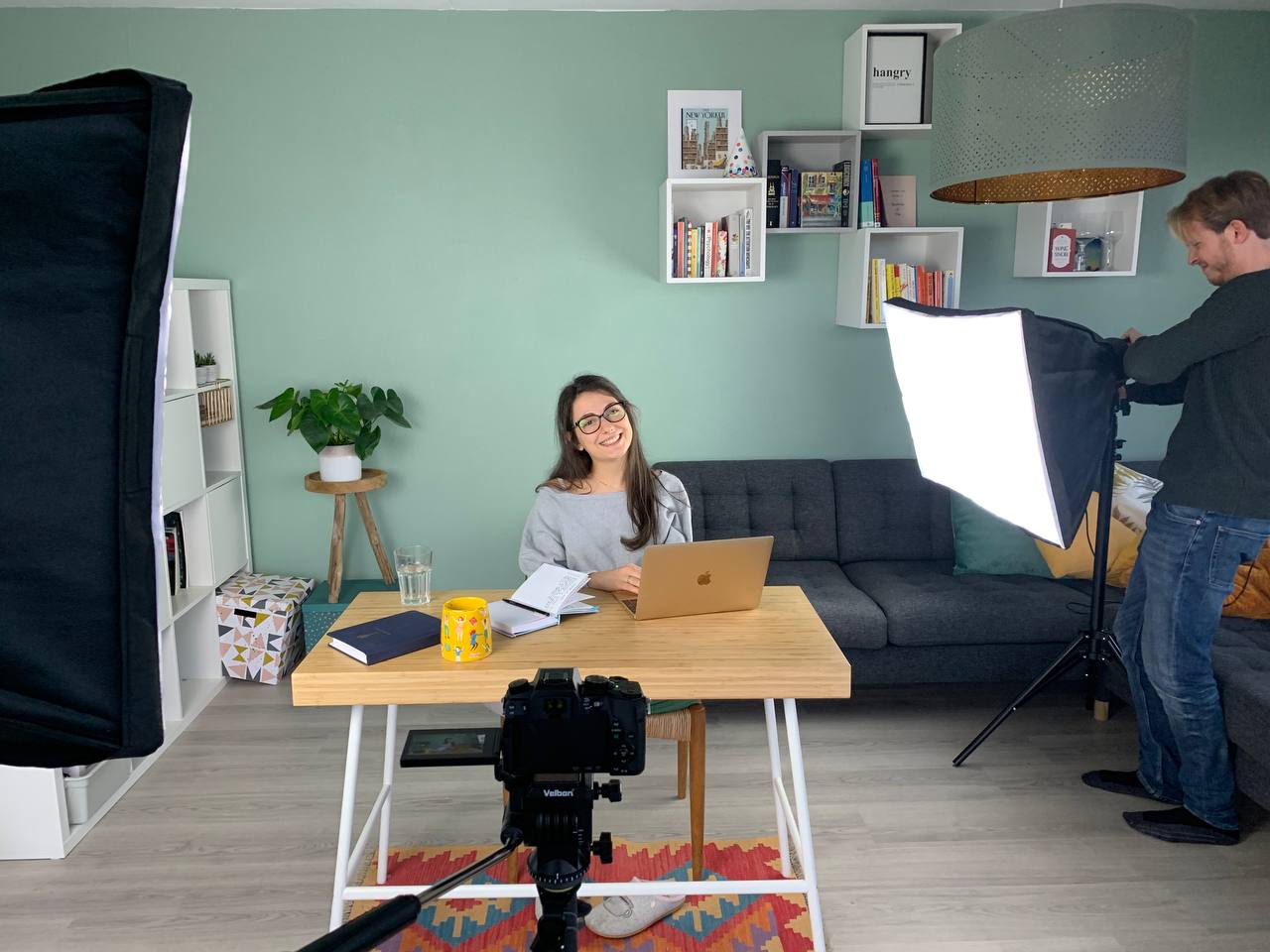
Radmila at a desk with a laptop during filming.
At work: monthly webinars — running since 2020.

How did you build your marketing? You said it was hard at first.

Marketing went from “we put up a story, checked the reach” to counting absolutely everything under the sun: leads, MQLs, SQLs, conversion from the landing page, from an application, missed calls — everything. At the very beginning it was blind marketing: got followers — great, moving on, and how many of them turn into clients and how much money each region brings, we didn’t look at.

The first girls grew the channel to somewhere around 15,000–20,000, mostly through paid ads. And our main tool became webinars — we started doing them every month back in 2020, and I still run them every month. They bring the warmest clients, the ones who convert the fastest. Many people think: webinars, who watches those now? But they work, if you do them right.

Then came Telegram — we now have 22,000–23,000 there too, and we grow it every month. Instagram, Telegram and webinars — those are the three main workhorses. And then we started adding cold traffic: ads on Facebook and Instagram, Google, Telegram Ads, SEO. It’s now seven different channels, each with its own conversion, its own results, its own budget. And all of it grew out of one Instagram account.

Radmila on set giving an interview to camera.
On set.

Webinars, admission case studies and scholarships — on the project’s website.

selfstartglobal.com

We built this system over five years. It took a long time — because there was no money to hire an expert who’d come in and put it all together at once. Such people cost a great deal on the market; we couldn’t afford them. So we dug in and figured it out ourselves.

Why her clients get into even the Ivy League

There are many similar products on the market. What makes you different?

I know Marina Mogilko — when I was starting out, she was the only blogger in this field. Back in 2015, when I was preparing to apply myself and watching her videos. Back then she was a real pioneer for me. And when she opened her own company, I thought: maybe I want something similar too.

Now, having established myself on the market, I see the differences from almost every company very clearly. First: we guarantee admission and take on financial responsibility. If a person did everything we recommended and didn’t get in, we’re ready to refund the money. Almost no one on the market does that: they either don’t guarantee anything at all, or they simply reapply the next year at their own expense.

We can afford this because we’ve already admitted more than 1,700 clients, and we’ve built up an enormous database: what grades, activities and résumés those admitted had, which universities took them and which rejected them. When a new client comes in, we look: here’s a person who got into Harvard or Oxford, here’s what they had — and here’s what you need to do. One, two, three. Not enough time in a year to get into the university you want — we suggest stretching it over two. And we don’t just give a plan, we guarantee it will work if you follow it. Our success rate is insane — 98–99%. If getting in within a year is unrealistic, we say so straight out, that we won’t sign up to the guarantee, but over two years — we’ll take you on and get you in.

And that’s not all. We have a whole ecosystem, not just a curator. The client has a teacher for all the entrance exams, as well as a career counselor, a visa consultant, a relocation expert. Everything in one place — no need to look for supporting people on the side. We also work on personal branding: for the client’s field, the curators find conferences, olympiads, topics for publications, help launch a project or a startup if they’re applying for business. A person comes in with an empty profile and leaves having grown as a personality and as a future expert in their field. And we package all of it beautifully and present it to the universities that provide funding and where admission is genuinely possible.

The freedom you dream of

Tell us about your mission. Has what you set out with at the start changed?

When I was employed, my big goal was simple — to work for myself and be free. Free from other people’s decisions: from not being allowed to step out for lunch, not being able to leave when you want, not being able to finish when you want. The employment format simply doesn’t suit me, I realized that a long time ago. I wasn’t a team player; other people’s missions didn’t fire me up.

My big goal was simple — to work for myself and be free

I wanted to do something that genuinely changes people’s lives. When I moved abroad myself, my life was turned upside down — I became the person I was meant to be precisely because of the move. I’d never have become her if I’d stayed in the comfort zone where your dad books your dentist appointments. And that life-changing experience I wanted to give to others. In law I felt no impact at all — some contracts, who does that help? But here I’m changing someone’s life.

And an entrepreneur’s freedom — did it turn out the way you dreamed?

I’ll say right away: it’s a fantasy notion. It seems like you’re free — but actually now you’re free to work all the time, 24/7. If I want, I work in the evening; if I want, on weekends.

I still remember how one of my managers told me you can’t eat at your desk — crumbs, supposedly, get into the laptop. And I thought then: I want to decide for myself where I get to eat. That’s the kind of freedom I was fighting for.

A woman in a world where everyone wants millions

How do you rate the entrepreneurial environment in the Netherlands — especially for women?

For several months in a row I went to a huge number of events for entrepreneurs — especially actively from 2022, when I left my job. Networking, meetings with investors, pitches. I joined associations — Dutch EdTech, something to do with startups, went to conferences. I was a mentor at three accelerators.

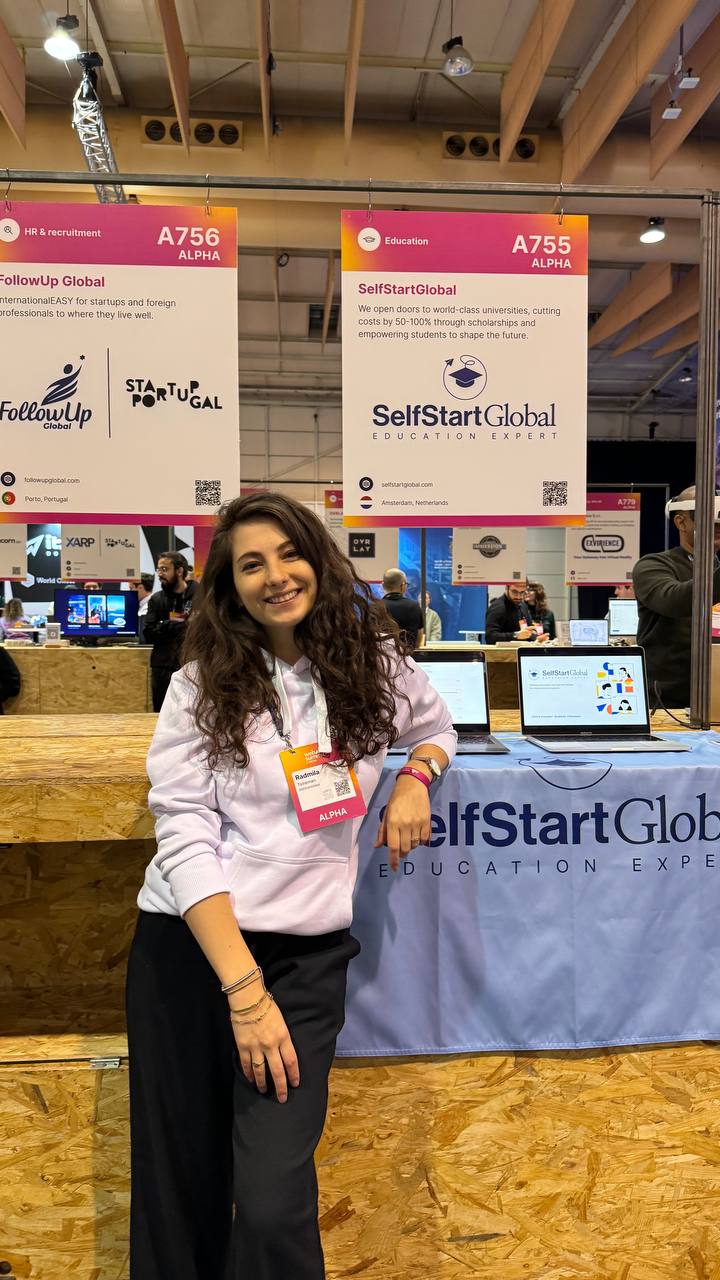
Radmila by the SelfStartGlobal stand at a startup event.
At a startup event, by the SelfStartGlobal stand.

And at some point I hit complete saturation from these empty meetings — this year I decided to stop going. I realized these events are worth attending only if you have a goal: to get money, to find a co-founder, or to recharge. For me it was mostly energy — to feel that I’m not alone in this world. But in essence they’re very empty conversations, and nothing came of them for me.

And another thing: as a woman in EdTech, I felt that the only interest was in crazy money, AI or subscription models. That’s my impression of Dutch investors and founders: everyone’s doing AI, everyone’s chasing millions. And when they hear you have education, helping people, not a tech startup — the interest usually fades. At the pitches around me it was eighty to ninety percent men, all with startups in fintech, Web3, AI, SaaS. And the women often come with ideas about sustainability, about how to change the housing market — something socially meaningful. The guys, though, come purely for the money. Too much of that masculinity — and I’m on a break from it for now.

Are there women among venture investors? How do investors generally treat women in business and impact-driven projects?

There are women among investors too, I’ve met them. And you know, there’s a sense that both female and male funds are specifically looking for women founders. I even had an offer from one VC, and one of the reasons they were willing to take me into their portfolio was precisely that I’m a woman. They said so outright. So support for women can be found, I believe that.

Support for women can be found. I believe that

But I ran into a different problem — almost none of the investors are interested in impact-driven fields, because everyone’s looking for something that pays off quickly. Our company grows organically, usually by 25–30% a year. It’s not a 2x or a 3x, but we cover our own costs, and I’m proud of that. When I showed those figures to venture funds, they didn’t even reply. Small investors weren’t interested in that kind of growth either.

In the end I decided there was no point and that I don’t actually need the money. Better to grow on my own, more slowly perhaps, but to own everything a hundred percent — without the pressure to return someone’s money as fast as possible. Their main interest is money, not impact. The fact that I didn’t manage to find investment I explain simply: I didn’t need it. But that doesn’t mean it’s not worth trying. If a startup’s life depends on investment, or you have a super-global idea — money can be found, you just have to approach the right people, maybe from other regions.

Have you encountered sexism? And being a foreigner?

Being a foreigner — no, I’ve never felt any different treatment because of it. But sexism, unfortunately, I have encountered. As a businesswoman you’re often treated differently, and most often it comes from men who couldn’t build a business of their own themselves: for some reason they decide that in front of them is “some girl” who now needs to be explained how things really work.

The most telling example is when my decisions are attributed to emotion. Say I end a collaboration or let someone go — and I’m asked point-blank whether it’s an emotional decision. I strongly doubt a man would ask another man that question.

And here’s what’s interesting: in my experience there was more sexism from people from the CIS than from the Dutch. With the Dutch nothing like that ever happened — they treat everything very respectfully.

What I came to understand about fear — and about myself

Let’s come back to you. What feelings did you deal with most — when you were job-hunting, leaving employment, building the business?

When I was job-hunting, there was a sense of having no way out. I knew in advance that it probably wasn’t what I wanted, and getting what I did want wasn’t working. I was rejected by the large law firms I dreamed of working at. Now I think — how good that they rejected me. Otherwise I’d have stuck around there and maybe never founded my own company. Everything works out the way it’s meant to.

I was rejected by the large law firms I dreamed of. And now I think: how good that they rejected me

And when I was leaving employment — that was a huge fear. How do you live without a stable salary that lands in your account every month? What if some month doesn’t go well, the expenses stay but there’s no income? I spent about four months weighing it up — to leave or not. It was genuinely frightening. But everything that’s frightening and lies outside the comfort zone — that’s exactly where you should go. That’s where the growth is. And it turned out to be the right decision.

What helped you not get stuck in that fear?

Rationalization. I broke the fear down into its parts: what exactly am I afraid of? That I won’t be able to earn, that at the end of the month there won’t be any money left. But when I broke it down month by month, I saw that a certain minimum amount always comes in, turnover is growing, there are more and more clients. And if I free up the thirty or forty hours a week I spent on the job and put them into the company — I’ll definitely manage to increase that amount. After all, it’s working now, when I only spend a couple of hours a day on it.

And the second thing — support. My husband supported me enormously, told me I needed to do it, that everything would be fine. I understood that I wasn’t in this alone. That gave me huge strength to make the leap forward.

What did you learn about yourself over these years?

That my level of stress resilience is now simply five hundred times higher than before. I’m almost impossible to throw off balance. There was so much — the COVID-19 pandemic, then the war between Russia and Ukraine, various ways of sending and receiving money being cut off, and theft inside the company, after which the person simply disappeared. And I came through all of it. Now I know for sure: whatever the situation, I’ll handle it, because I have a track record of how I’ve handled things before. I can rely on myself.

My level of stress resilience is now five hundred times higher. I’m almost impossible to throw off balance

And I also realized that I’m very persistent and don’t give up under any circumstances. That’s probably the main lesson in business. If someone asks why we haven’t shut down yet — it’s only because we kept moving forward. Sometimes it doesn’t work for six months, I don’t pay myself a salary, it doesn’t work, it doesn’t work, it doesn’t work — and you keep going anyway and don’t give up. And at some point everything you’ve been doing finally starts to give a boost, and the company reaches a new level. But all of it could have collapsed if you’d stopped.

And finally. One phrase for a woman who’s thinking about starting her own business right now.

Can I have more than one? You need to approach it with a clear head. I’d love to say “drop everything and go for it,” but in reality there’ll be a great deal of stress and it’ll be very frightening. I myself came to business while working full-time and with a large safety cushion. And I advise all entrepreneurs to start while you’re working somewhere — it’s the best way not to drive yourself into cash-flow gaps, because you have a stable income. Grow the business on the side until you’re completely sure you can set out on your own.

It’s not the advice people want to hear. But it’s honest. No diving in headfirst — a cool head, cold calculations, rational decisions. Cold mind. And keep acting, acting, acting — and don’t give up. Then everything will work out.

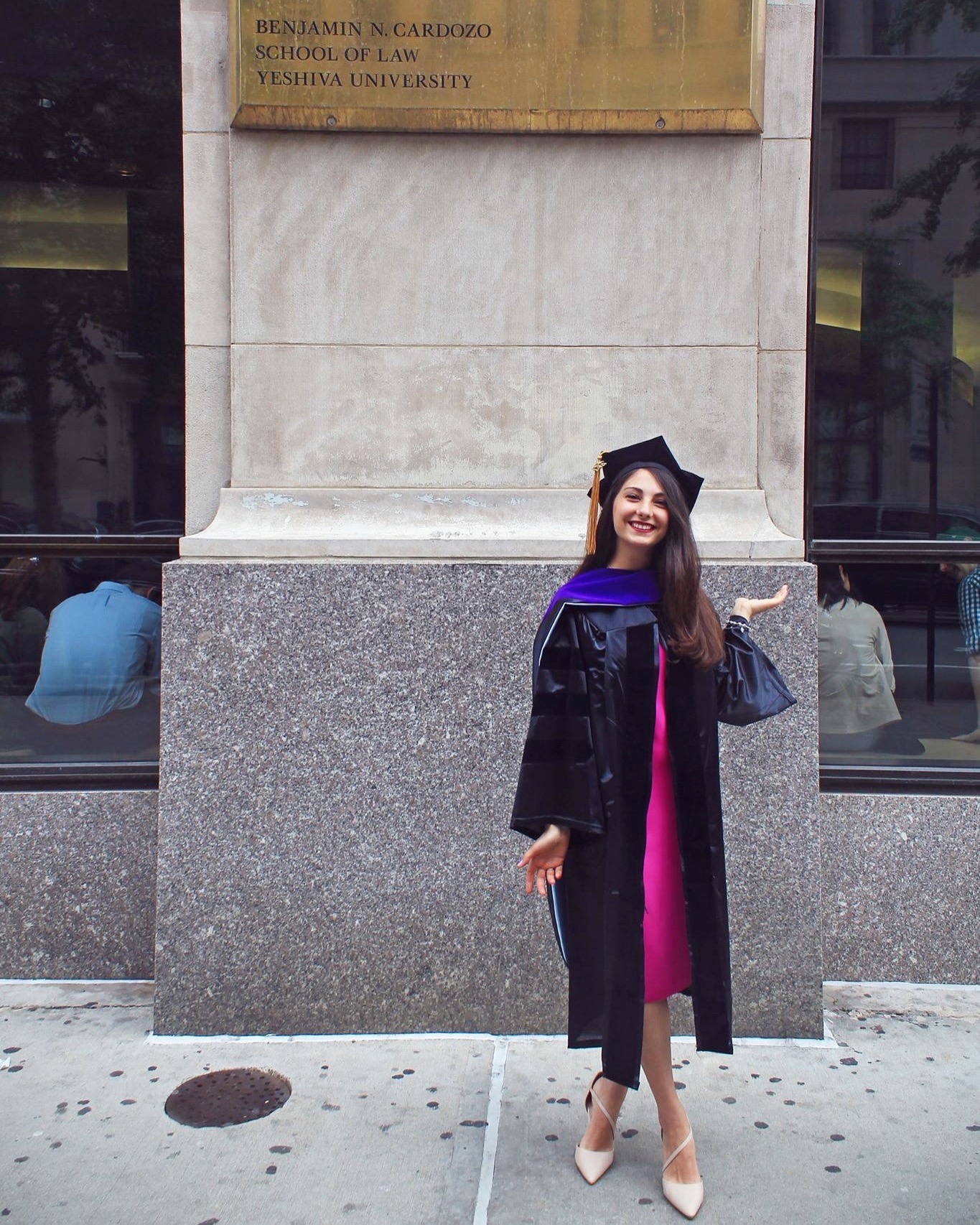
Radmila in a graduation gown outside Cardozo School of Law, Yeshiva University.
Graduation from Cardozo School of Law, Yeshiva University, New York.

Radmila’s story continues every day — on the SelfStartGlobal project.

Instagram: @selfstartglobal
Key Lessons

What this story teaches

  • Start without quitting. Build the business alongside your job. A stable salary is the cushion that saves you from cash-flow gaps and from panic in the first bad month.
  • Break your fear down into its parts. “I won’t earn enough” is not a fact but an emotion. Count the real numbers month by month, and the fear becomes manageable.
  • Hire strong people earlier than seems necessary. An expert HR is not a “for later” luxury but the person who turns the chaos of eleven people into a team with departments and a culture.
  • Don’t chase investment for investment’s sake. Organic growth of 25–30% a year and a hundred percent control are sometimes worth more than other people’s money and the pressure to return it quickly.
  • Don’t give up — literally. Everything you build often starts to bear fruit exactly when most people have already stopped. To keep going is itself the strategy.
Resources mentioned
Related Insights

Explore the research behind this story

Related Stories

More journeys

Back to Stories