WWomen & Work
All Stories
Netherlands · 9 min read

Elena Ar

Learning & Development Specialist

Education ops → Learning & Development
I was riding my bike, crying, thinking it had all been for nothing. Then I got a job offer.
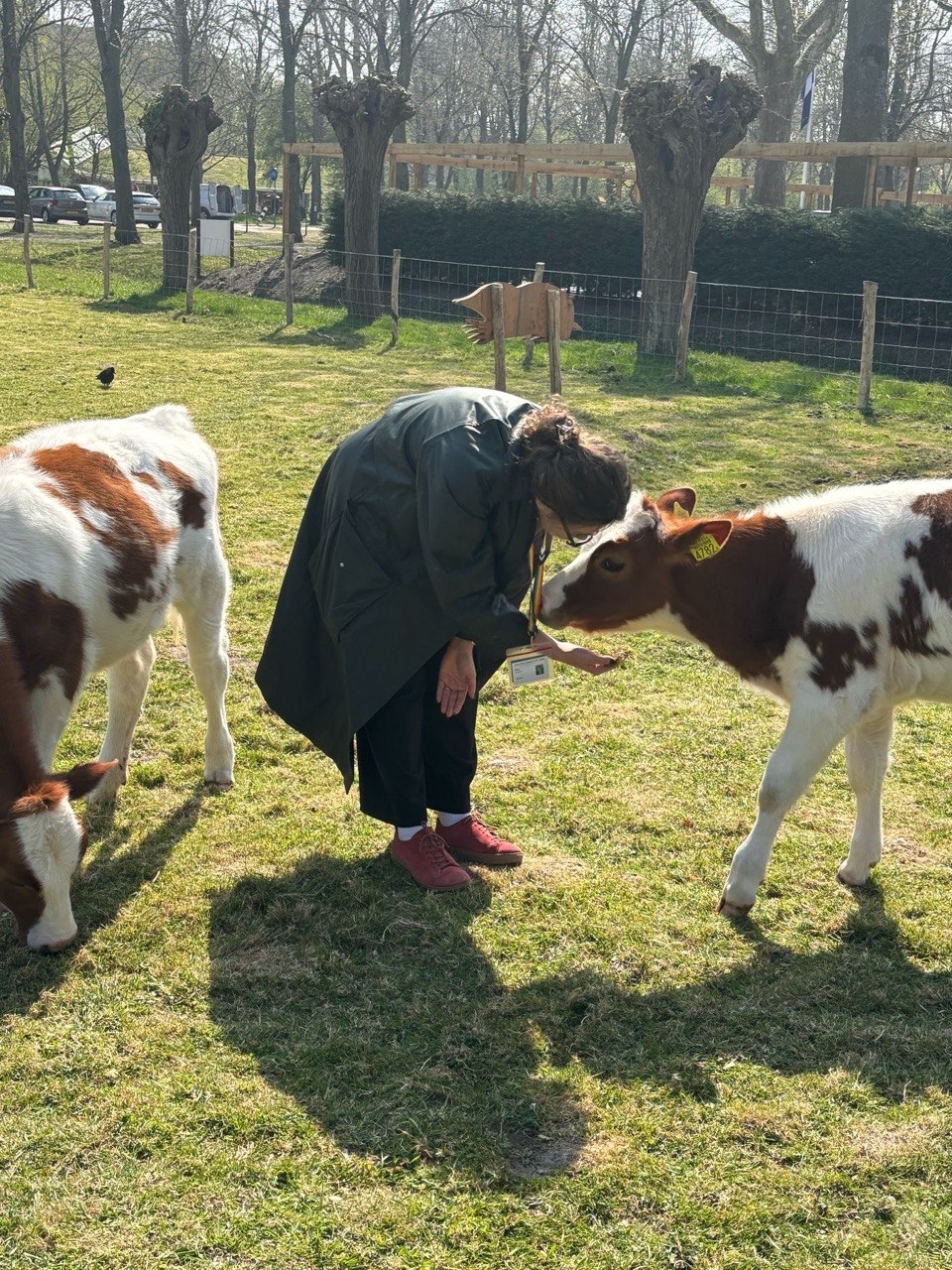
Elena in a dark coat and red shoes feeding a calf in a Dutch field.
Quick Facts
Industry
Home furnishing retailer
Country
Netherlands
Current role
Learning Creator & Learning Designer
Previous field
Education operations & project management
Family status
Married
The Story

Relocation is rarely just about paperwork and suitcases. More often it is also about rebuilding yourself professionally — and learning how to speak about yourself in a new language. Elena's story is exactly that.

Why a new field, not the old one

I worked in education in Russia, but mostly on the operations and project management side rather than instructional design. I always wanted to move closer to designing learning programs, but my responsibilities were operational.

I realised that if I didn't make the leap now, I would probably remain in operations forever. Moving to the Netherlands gave me an opportunity to make that transition through education. Finding a job directly from Moscow felt impossible — my English wasn't strong enough, I had never lived abroad, and interviewing in English felt incredibly far beyond my reach.

A master's degree became a bridge into a new professional reality.

Relocating through education

The Netherlands won for a very practical reason: it was the only master's program I found that offered a pre-master's pathway. That meant I could move from my background into the master's without doing another bachelor's first.

I didn't get a full scholarship, but the university recognised both my academic record and the extra credits from studying at two Russian universities. They offered me a tuition discount and waived some course requirements.

The hardest part — English

English. Without question. I dedicated about a year to it: devices, TV shows, learning materials, my whole daily environment switched to English. I tried to eliminate as much Russian-language content as possible.

I took Academic IELTS on February 24, 2022. I remember very little about that day — only a feeling of complete darkness inside. But I still went and took the test. I scored exactly the minimum the university required: 6.5.

A teacher who refused to switch to Russian helped tremendously. I asked her many times — she always said no. I also used Magoosh, which prepares students for IELTS, TOEFL and GMAT.

Job search as a job

My strategy was simple: find at least three relevant vacancies every day and submit applications to three or four positions every week. Ironically, the offer eventually came from one of the very first positions I applied for — but the hiring process lasted nearly three months, so I couldn't afford to stop applying.

From my experience, Learning & Development is highly open to international professionals. Many L&D specialists here are expats, and relevant academic qualifications are valued because many people entered the field through internal progression rather than formal education.

Six interviews and an offer after tears

Six interviews: HR screening, a second HR call with two specialists, the hiring manager, an assessment task and presentation, a psychological assessment with a debrief, and finally an in-person meeting with the manager and a future colleague.

After the final interview I waited a week for the answer. Friday came. The workday ended. Nobody called. We had travelled from Germany to the Netherlands for the interview, and my husband had even booked me a hotel in a quieter neighbourhood so I could sleep. That evening, I got on my bike and rode about 60 kilometres into the countryside. I was crying, convinced the whole process had led nowhere.

Well, that bike ride was unnecessary. Go buy yourself a bottle of wine.

Then, around seven in the evening, an unfamiliar number called. I answered. They told me they wanted to make me an offer. I was standing in the middle of a field, in tears, next to my bicycle, trying to understand what was happening.

CV, LinkedIn and the User Manual

For every application I adjusted wording, action verbs and emphasis to align with what the company was looking for. I don't know exactly how much it influences algorithms, but careful customisation helps.

For my offer company I designed my resume as a 'User Manual for Me.' When I came up with the idea, I felt so embarrassed I almost didn't submit it. My husband sat me down a few hours before the deadline and said: 'Send it.' As it turned out, that was exactly what the company remembered most.

Sometimes the thing you're most self-conscious about is exactly what makes you memorable.

Inner dynamics

I'm an anxious person, and that period amplified it. Running helped — I needed somewhere to channel the nervous energy. Treating the job search like a job helped too: dedicated time, concrete actions, instead of constant chaos.

I started collecting rejections. I applied to highly competitive companies and thought: 'Great, another rejection for the spreadsheet.' I learned that I'm scared of many things — and that I don't give up, even when I'm scared.

Two pieces of advice from my husband made all the difference: treat job searching like a job, and prepare your STAR(L) stories in advance. You can't reinvent yourself in every interview. It helps enormously to map out your experiences beforehand — difficult situations, mistakes, conflicts, achievements. Not perfect stories. Real, human ones.

Key Lessons

What this story teaches

  • Treat the job search like a full-time job: fixed hours, concrete actions, weekly application targets.
  • Prepare a bank of STAR(L) stories in advance — real, imperfect ones beat polished platitudes.
  • Customise your CV per role: same experience, different emphasis.
  • Don't kill the idea you're embarrassed by — it's often the one that gets remembered.
  • If you need to bridge from your old career to a new one, a master's abroad can be the bridge.
Resources mentioned
  • Magoosh — IELTS / TOEFL / GMAT preparation
  • LinkedIn — primary platform for job searching
  • STAR(L) story bank — well-prepared answers to behavioural questions
  • Nuffic credential evaluation
Related Insights

Explore the research behind this story

Related Stories

More journeys

Back to Stories